



29 September 2026
With bluetongue virus (BTV) continuing to make headlines across the UK, farmers are understandably looking closely at the measures they can take to protect their animals and reduce the risk of disease spread.The most important point to understand is that bluetongue is primarily a vector-borne disease. BTV is predominantly transmitted by infected Culicoides biting midges, rather than being spread directly from animal to animal in the same way as diseases such as foot-and-mouth disease.
That means cleaning and disinfection (C&D) should not be presented as a standalone control measure for bluetongue.
However, this does not mean that hygiene and biosecurity can be overlooked. In fact, DEFRA and APHA specifically identify maintaining good hygiene and biosecurity as part of key measures that farmers can take to help prevent bluetongue from spreading.
Think beyond the animal housing
Farm operations involve a constant movement of animals, people, vehicles, equipment and organic material between locations. Therefore, transport vehicles, auction houses, abattoirs and other locations where livestock would be present must be considered.
Midges are tiny insects and can easily be carried with vehicles and equipment when conditions allow. A vehicle that has transported livestock may also carry mud, dung, bedding and other organic material that provides shelter for insects.
This is why cleaning is so important and should always come before disinfection.
Removing manure, mud, bedding and other organic contamination from livestock trailers, ramps, floors and equipment physically removes material that can harbour insects and microorganisms. Once the surface has been thoroughly cleaned using a formulated detergent, an appropriate disinfectant can then be applied to the remaining surfaces. It is key to understand that disinfectants are less effective in high organic matter environments.
This approach is not about claiming that disinfecting a trailer will prevent a midge from transmitting BTV. Instead, it forms part of a wider biosecurity programme designed to minimise the opportunities for disease and potential vectors to move between premises.
Vehicles: a key biosecurity consideration
Livestock transport creates an important connection between farms. A vehicle may visit multiple premises during a single day especially if transporting animals on behalf of farmers, meaning that effective cleaning and disinfection between movements is an essential part of responsible livestock biosecurity.
Defra's bluetongue control framework has previously included measures such as applying insecticide to livestock transport vehicles to minimise the risk of infected midges being carried outside control zones. This demonstrates an important principle; vehicle biosecurity should consider both the disease and its vector.
Cleaning should focus particularly on areas where organic contamination accumulates, including:
• Floors and floor channels
• Loading ramps
• Wheel arches and lower vehicle areas
• Gates and partitions
• Areas around dung and bedding (holding pens, sheds, handling facilities)
• Trailer corners and difficult-to-clean areas
• Equipment used during loading and unloading
Once visibly clean, appropriate Defra approved disinfection should be carried out using a product at the correct concentration and with sufficient contact time in line with microbiological profiles.
Don't forget tools and equipment. Livestock husbandry involves a wide range of equipment that comes into contact with animals, and can become contaminated with organic material, including blood.
This is particularly relevant because BTV is a viraemic disease. Research from The Pirbright Institute found that infectious BTV-3 could be isolated from sheep blood for up to 28 days after infection.
This reinforces the importance of good hygiene around equipment that may become contaminated with blood or other animal material.
Again, this should not be interpreted as suggesting that BTV is primarily spread by contaminated equipment. The principal transmission route remains infected Culicoides biting midges. Instead, it demonstrates why good cleaning and disinfection practices remain an important component of overall farm biosecurity.
Cleaning first, disinfecting second
One of the most important principles of any effective C&D programme is simple - you cannot effectively disinfect what you have not properly cleaned.
Organic material can interfere with the active of disinfectants and can physically protect microorganisms from contact with the disinfectant.
The process should therefore be:
REMOVE → CLEAN → DRY (IF POSSIBLE) → DISINFECT → DRY
- First remove livestock, bedding, manure and other gross contamination.
- Then clean surfaces thoroughly using a formulated detergent designed to remove remaining organic matter in agricultural environments.
- Once surfaces are visibly clean and dry, apply the appropriate disinfectant at the correct concentration and ensure adequate coverage and contact time. (If you have to disinfect onto a wet surface, account for the further dilution of the disinfectant from the remaining surface water.)
- Where practical, allowing surfaces to dry before returning animals or equipment can further support good hygiene management.
Choosing the right disinfectant
Where a notified disease outbreak has been confirmed, it is a legal requirement that farmers use a Defra approved disinfectant at the correct dilution.
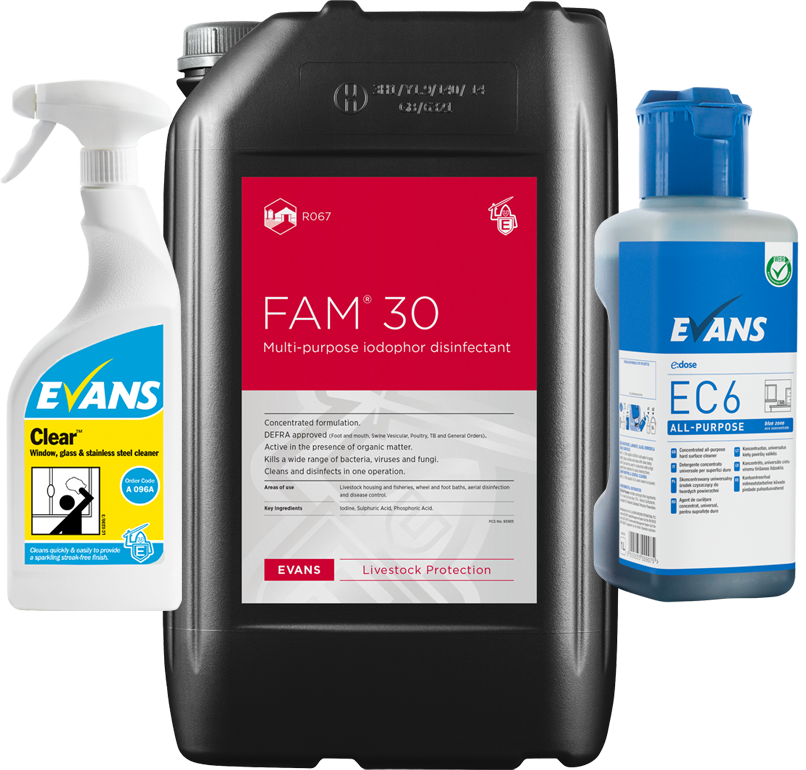
FAM 30 from Evans Vanodine is a multi-purpose iodophor disinfectant that is listed by Defra as an approved disinfectant under the General Orders and is formulated to remain effective in high organic matter environments. The current Defra listing gives FAM 30 a General Orders dilution of 1:49.
FAM 30 is also authorised under the Biocidal Products Regulation and is designed for use across a wide range of agricultural biosecurity applications.
For any notified disease outbreak, users should always follow the current product label and the relevant Defra/APHA requirements.
A layered approach to bluetongue biosecurity
There is no single measure that will eliminate the risk of bluetongue.
Effective management requires a layered approach, including:
1. Vector management
Reducing exposure to infected biting midges is central to bluetongue control. Defra advises considering housing animals in buildings that help keep biting midges out, particularly around dawn and dusk when midge activity can be heightened.
2. Movement management
Following current livestock movement restrictions, licences and disease-control requirements is essential.
3. Animal monitoring
Farmers should remain vigilant for clinical signs and report suspected bluetongue immediately through the appropriate channels.
4. Vehicle biosecurity
Livestock transport vehicles and vehicles travelling between farms and livestock handling facilities should be thoroughly cleaned to remove manure, mud and other organic material, followed by appropriate disinfection.
5. Equipment hygiene
Reusable equipment should be cleaned and disinfected regularly, particularly where it becomes contaminated with animal material or blood.
6. Good farm hygiene
Maintaining clean, well-managed livestock environments reduces the overall biosecurity risk and supports control of a wide range of livestock pathogens.
Cleaning & Disinfection isn't the whole answer – but it still matters
Bluetongue presents a useful reminder that biosecurity is not simply about choosing a disinfectant. Because BTV is predominantly transmitted by biting midges, C&D cannot replace vector control, vaccination, surveillance or movement controls.
But neither should C&D be dismissed as irrelevant.
Keeping vehicles, housing, tools and equipment clean and appropriately disinfected helps maintain a strong overall biosecurity barrier and reduces the opportunity for contaminated organic material, pathogens and potentially vectors to move between premises.
For livestock keepers facing the ongoing bluetongue risk, the message is therefore simple:
• Control the vector. Follow movement controls. Monitor your animals. And don't let basic farm hygiene slip.
• Good biosecurity works best when every layer of protection is considered together.